Underwire Pain: Why Your Bra Hurts and How to Fix It
Last updated: March 28, 2026
Underwire pain is not something you should just tolerate. The location of the pain gives a strong clue about what is wrong with your fit—and what kind of fix will actually help.
How this page helps
This page helps you understand common reasons underwire pain happens and what fit or bra-design changes may help.
Method
The advice here is based on common bra-fit causes such as band tension, cup size mismatch, wire shape mismatch, and bra wear patterns.
Note
This page offers bra fit guidance only and does not replace medical advice. If pain is persistent, severe, or linked with skin changes or breast changes, consult a qualified medical professional.
Expert Reviewed
By Pooja Panwar • Lead Bra Fit Specialist
Important: if an underwire hurts, that is a fit signal — not something you should just accept. A good underwire bra should support you without stabbing, bruising, or digging.
Why does underwire pain happen?
Underwire pain often happens when the wire shape does not match your body, the cup is too small, the band is too tight, or the bra is worn out. A well-fitted underwire should feel secure, not sharp or painful.
Common causes
- Cups are too small or too shallow
- Wire shape does not match your breast root
- Band feels too tight or too rigid
- The wire is bent, damaged, or poking through
What to try next
- Stop wearing the bra if it feels sharply painful
- Recheck cup and band size
- Try a different wire shape or softer bra style
- Use the fit checker before buying another size
Quick answer
Most likely causes
- • Cups are too small or too shallow
- • Underwires are too narrow or the wrong shape
- • Band is too tight or the gore is too tall
Most useful fixes
- • Diagnose pain by location, not just by the size label
- • Try better cup depth, wire width, or lower-gore styles
- • Stop wearing clearly painful or damaged bras
Check this first
Before changing size randomly, look at where the pain actually happens. That usually tells you whether the problem is gore pressure, narrow outer wires, shallow cups, or a bra that is simply damaged.
Pain is sharp at the center gore
This often points to gore height, band tension, or cup mismatch rather than the whole bra being unusable.
Pain is near the outer wire
This usually points more toward narrow wires, small cups, or side tissue being trapped.
Pain is strongest at the bottom of the wire
This often happens when shallow cups are being pushed downward into the ribs.
The wire feels bent, twisted, or suddenly sharper
That is often a damaged-bra problem, not a small fit issue to keep adjusting around.
How to diagnose underwire pain properly
The most useful clue is not just that the bra hurts — it is where it hurts. Pain at the center gore usually means something different from pain near the underarm or pain at the ribs.
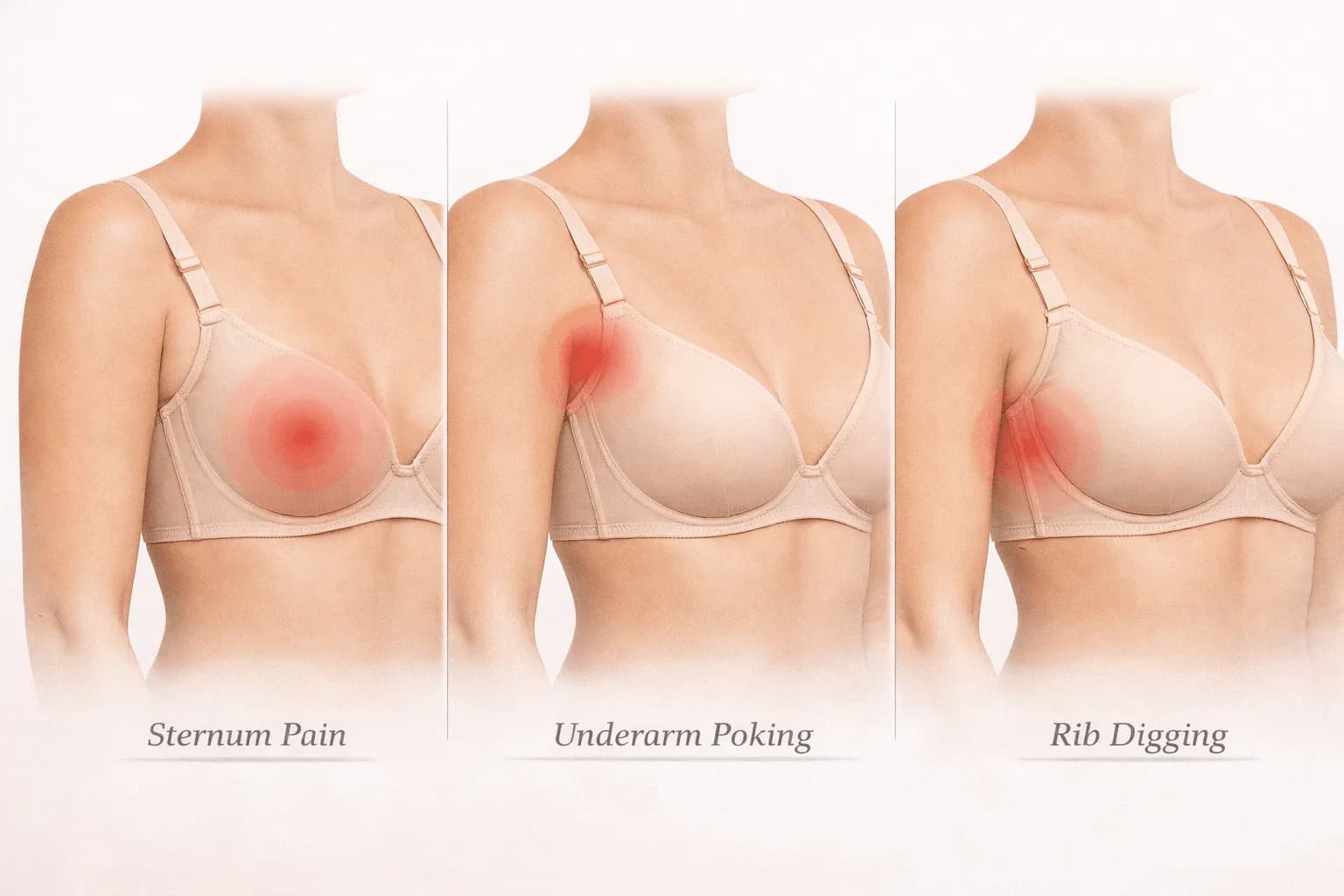
Pain location is often the fastest clue. Center-gore pressure, outer-wire poking, and rib digging usually point to different fit problems.
| Where it hurts | Likely cause | What to try |
|---|---|---|
| Center of chest / sternum | Gore too tall, band too tight, or cup mismatch forcing pressure inward | Try a lower-gore style, reassess band size, and check whether the cups are the right depth and shape. |
| Underarm / outer side | Cups too small or underwires too narrow | Try more cup volume, wider wires, or stronger side-support styles. |
| Bottom ribcage | Cups too shallow, causing the bra to be pushed away and down | Try deeper cups, unlined seamed bras, or a shape that matches projected breasts better. |
| Pain increases after hours of wear | Minor fit mismatch becoming pressure buildup over time | Reassess the whole fit instead of just tightening or loosening straps. |
What underwire pain usually means
A correctly fitted underwire should surround the breast tissue and rest against the body without stabbing, pinching, or bruising. If it hurts, the problem is usually not that underwires are “bad” — it is that the bra’s size, shape, or structure is mismatched to you.
Pain is a diagnostic signal. Instead of just putting up with it, use the pain location to work backward toward the real fit issue.
Choose the right fix first
Underwire pain usually gets better faster when you match the fix to the pain pattern. That is much more useful than simply sizing up randomly or hoping the bra will soften with wear.
Start with gore height and band tension
Pain is at the center gore
Try a lower-gore style or reassess whether the band is too firm and the cups are forcing the center inward.
Start with wire width
Pain is at the underarm
If the outer wire sits on tissue, you may need more cup room, wider wires, or stronger side support.
Start with cup depth
Pain is at the ribs
This is often a shallow-cup problem. The breast pushes the bra away and the wire digs downward.
Start with damage check
The bra suddenly feels much worse than before
A bent wire, broken casing, or harsher-than-usual pressure can mean the bra itself is no longer safe to wear.
1Pain at the center gore / sternum
If the center gore digs painfully into your sternum, the gore may be too tall, the band may be too tight, or the cups may be the wrong shape and forcing the center forward into your chest.
Try a lower-gore or plunge style if your sternum is sensitive. Also reassess whether the band is too tight or whether the cups are sitting flat enough against your body.
2Pain near the underarm / outer side
Underarm poking usually means the wires are too narrow, the cups are too small, or the bra is sitting on breast tissue instead of fully surrounding it.
Try more cup volume, wider wires, or stronger side-support construction. This often overlaps with side spillage and weak outer-cup containment.
3Pain at the ribs / bottom of the wire
Rib digging often means the cups are too shallow. When the cups do not have enough depth, the breasts push the whole bra away from the chest and force the wires down into the ribcage.
Look for deeper cups, softer cup construction, or unlined seamed bras that adapt better to projection than stiff shallow molded cups.
Damaged bra vs fit issue
Some underwire pain is a fit problem. Some is a damaged-bra problem. It matters which one you are dealing with, because a damaged wire is not something to keep “testing.”
More likely a fit issue
- • Pain happens in a specific area but the wire looks normal
- • The pain pattern changes with different bra styles
- • The bra feels “off” rather than sharply broken
More likely a damaged bra
- • The wire is bent, twisted, or poking through the casing
- • One side feels much sharper than the other
- • The pain is immediate and severe every single time
If the wire is bent, twisted, poking through the casing, or the pain is sharp and immediate every time you wear the bra, stop wearing it and replace it. That is usually a damaged-bra issue, not something to troubleshoot with minor adjustments.
Best bra styles for reducing underwire pain
The best style depends on where the pain happens. Matching the bra structure to the pain location usually works better than just sizing up randomly.
Best for sternum pain
Lower-gore or plunge bras can reduce pressure if the center gore is too tall or too firm.
Best for underarm poking
Wider-wire bras and stronger side-support styles usually work better when the wire is sitting on outer breast tissue.
Best for rib digging
Unlined seamed bras or other deeper-cup constructions often reduce downward pressure better than shallow molded cups.
Future recommendation slot
Editor’s picks for pain-reducing bra styles could go here
This is the ideal place for future product cards such as a lower-gore bra for sternum pain, a wider-wire bra for underarm poking, or a deeper seamed bra for rib digging.
Common mistakes that make underwire pain worse
Related next steps
If underwire pain keeps happening, these pages can help you check size, spot fit problems, and explore better-fitting options.
Frequently asked questions
Is underwire pain normal in a bra?▼
No. A properly fitted underwire bra should feel supportive, not painful. Pain usually means the size, wire width, cup depth, or bra style is wrong for your body.
Why does my underwire hurt in the middle of my chest?▼
Pain at the center gore often means the gore is too tall, the band is too tight, or the cup shape is wrong and the bra is being forced into your sternum.
Why does my underwire poke near my armpit?▼
Underarm poking usually means the cups are too small, the wires are too narrow, or the wire shape is wrong for your breast root width.
Why does my underwire dig into my ribs?▼
Rib digging often happens when the cups are too shallow, so the breasts push the whole bra away from the chest and force the wire downward into the ribs.
Can a wrong cup size cause underwire pain?▼
Yes. Cups that are too small, too shallow, or the wrong shape can all make the wire sit in the wrong place and create pressure or poking.
Can sister sizing help underwire pain?▼
Sometimes. If the band is too tight but cup volume feels close, sister sizing can help. But if the problem is wire width or cup shape, you may need a different bra style too.
What bra styles help reduce underwire pain?▼
Lower-gore styles, wider-wire bras, unlined seamed bras, and shape-matched full coverage bras often help more than stiff shallow molded bras.
Should I keep wearing a bra if the underwire hurts?▼
No. Repeated underwire pain is a sign that the fit is wrong. Continuing to wear it usually increases discomfort rather than helping the bra 'break in'.
When is underwire pain a damaged bra problem, not just a fit problem?▼
If the wire is bent, twisted, poking through the casing, or feels suddenly sharper than before, the bra may be damaged. In that case, stop wearing it rather than trying to adjust around the pain.
What to do next
Let's stop the pain at the source
Underwire pain is a sign to diagnose, not ignore. Start with your size, then compare cup shape, wire width, and bra construction.