Why Is My Bra Band Riding Up?
Last updated: March 28, 2026
A bra band that creeps up your back throughout the day is one of the most common—and annoying—fit problems. Here is what usually causes it, what to check first, and how to fix it properly.
How this page helps
This page helps you understand why a bra band rides up, what it usually means, and what to try next for a more secure fit.
Method
The guidance on this page is based on standard bra-fit principles involving band tension, cup balance, strap adjustment, and sister-size logic.
Expert Reviewed
By Pooja Panwar • Lead Bra Fit Specialist
Why does a bra band ride up?
A bra band usually rides up because it is too loose to anchor properly around your ribcage. Sometimes cup imbalance, over-tightened straps, worn-out elastic, or a less stable bra style can make the problem worse.
Common causes
- Band is too loose
- Cups are not balanced correctly
- Straps are doing too much of the support
- The bra is stretched out with wear
What to try next
- Try a firmer band first
- Recheck your measurements
- Use sister sizing if the cups feel off
- Use the bra fit checker for a wider diagnosis
Quick answer
Most likely cause
- • Your band is too loose
- • The back of the bra is not anchored to your ribs
- • The straps may be overcompensating for a weak band
Most useful fix
- • Go down one band size
- • Go up one cup letter to keep similar volume
- • Use sister sizing before blaming the straps
Check this first
Before you assume the whole bra size is wrong, look for these common signs. They can quickly tell you whether the real issue is the band, the cups, the straps, or an older bra that no longer supports well.
Back climbs upward
The band should stay level. If it keeps moving higher, it is not anchoring properly.
Support feels weak
If the straps feel like they are carrying everything, the band is probably too loose.
Bra feels worse after strap tightening
That usually points to a band problem first, not a strap problem.
New bra only works on tightest hook
That is a strong sign the band started too loose from day one.
How to diagnose the band riding up issue
Put on your bra and check the back in a mirror. The band should sit completely level across your mid-back, parallel to the floor, at the same height as the underwire or lower band in the front.
If the back curves upward toward your shoulder blades, forms a U shape, or keeps creeping higher during the day, the bra is not anchored properly and you are dealing with the classic riding-up problem.
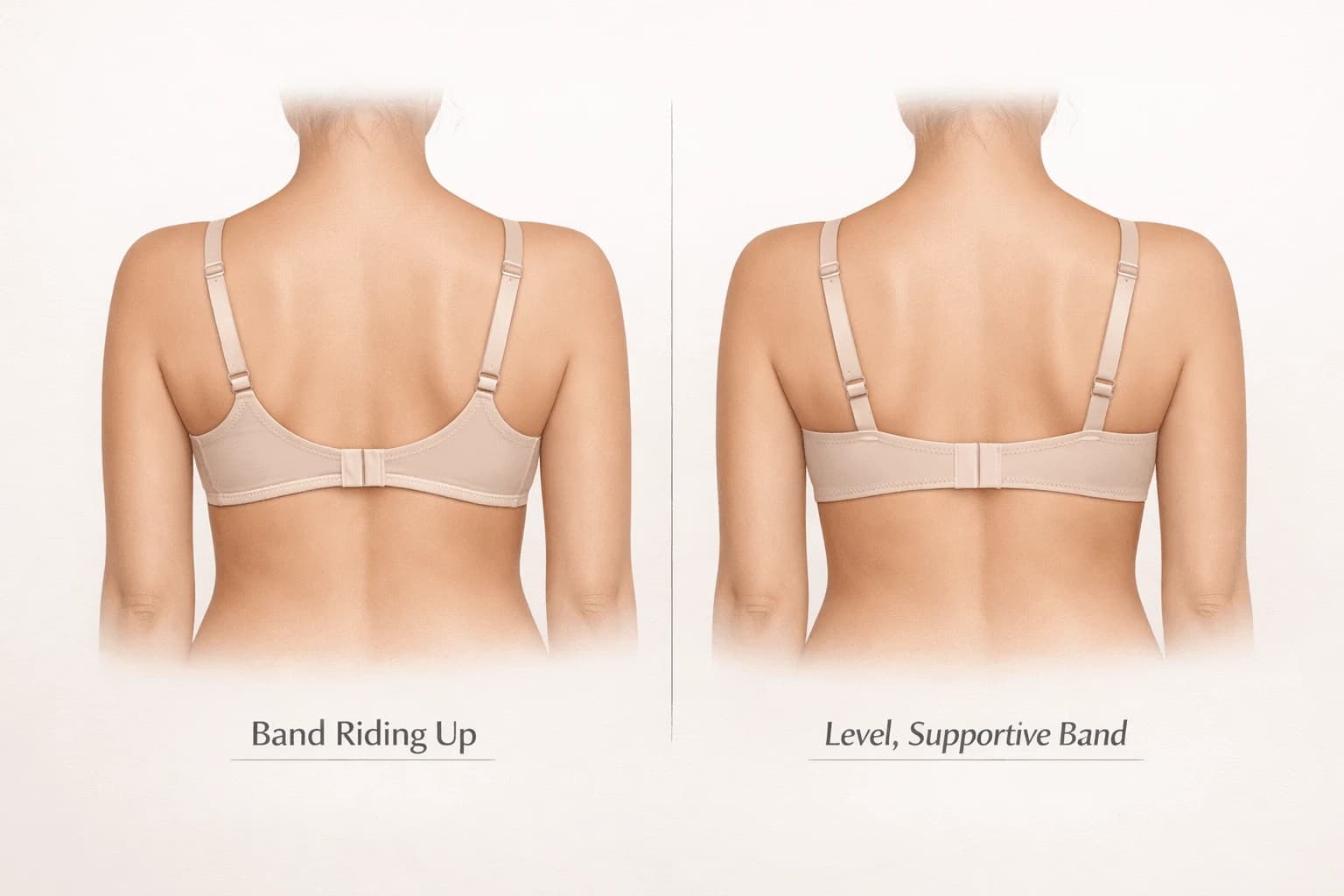
A level band usually means the bra is anchoring correctly. A back band that climbs upward usually means the support is not coming from the right place.
| What you notice | What it usually means | What to try |
|---|---|---|
| The back of the band sits higher than the front underwire line | The band is too loose to anchor properly | Try a smaller band and compare support before tightening the straps |
| The bra feels like the straps are doing all the work | The band is not carrying enough support | Reduce the band size and adjust cups using sister sizing if needed |
| Tightening straps makes the back ride even higher | The loose band is being pulled up the spine | Reset strap length and fix the band size first |
| A new bra only feels snug on the tightest hook | The band is already too large | Choose a smaller band size from the start |
Cause and fix table
Band ride-up is often a band problem, but not always. This quick table helps you separate a loose band from cup imbalance, worn elastic, or a style that simply feels less stable on your body.
| Possible cause | What it looks like | What it usually means | Best next fix |
|---|---|---|---|
| Band too loose | Back rides up, support feels weak, bra shifts during the day, band feels easy on loosest hook | This is the most common cause | Go down one band size and retest before changing anything else |
| Cup balance is off | Band rides up and cups also gape, wrinkle, or feel unstable in front | The bra may need a sister size or a different cup fit | Check your size again, then test a firmer band with a cup adjustment |
| Straps are over-tightened | Band gets pulled upward more after tightening straps, shoulders feel strain | The straps are compensating for poor band support | Loosen the straps slightly and fix the band size first |
| Old stretched-out bra | This bra used to fit, but now rides up and feels less supportive than before | The elastic may have lost recovery | Retire the bra or compare it with a newer bra in the same size |
| Style feels unstable on your body | Size seems close, but the back still feels unsupportive in certain designs | Construction may be part of the problem | Try wider back wings or a leotard/U-back style for more anchoring |
The "seesaw" physics
Your bra band is responsible for providing most of the support for your breasts. When a band is too large, it cannot grip your ribcage properly. Because it is loose, the weight in the front pulls the bra downward. Just like a seesaw, when the front drops, the loose back lifts upward.
Tightening your shoulder straps will usually make this worse. It pulls the loose back band even higher instead of fixing the real support problem.
How to fix it permanently
In most cases, you need a smaller band. To keep the cups balanced, use the sister size logic instead of changing the band alone.
Step 1
Band down
Move to a firmer band so the bra can anchor properly.
Step 2
Cup up if needed
Keep similar cup volume by adjusting with sister sizing.
Step 3
Recheck straps
Adjust the straps only after the band feels level and secure.
Example: if your 36C rides up, try a 34D.
When to change styles instead of only changing size
If your size looks close in theory but the back still feels unstable, the issue may be the bra’s construction rather than the size tag alone.
U-back / leotard back
These styles angle the straps inward and can help the back feel more anchored. See how different bra types affect support and back construction.
Wider back wings
A wider back with more hook coverage spreads tension over a larger area. That often feels more stable and can reduce upward movement through a full day of wear.
A style change is most worth testing when the band size feels close, but the bra still feels unstable in the back, awkward at the straps, or generally unsupportive compared with other bras you own.
Common mistakes that make it worse
Related next steps
If your band rides up, these pages can help you confirm your size, troubleshoot the cause, and test better alternatives.
Frequently asked questions
Does a bra riding up mean the band is too small?▼
No, it usually means the opposite. A bra band rides up because it is too large and too loose to properly anchor to your ribcage, so the weight in the front pulls the back upward.
Should my bra sit high or low on my back?▼
Your bra band should sit level across your mid-back, roughly parallel to the floor. The back should stay at about the same horizontal level as the underwire or lower band sits in the front.
Why does tightening my straps make the band ride up worse?▼
If your band is already too loose, tightening the straps simply pulls the loose back upward. The band should provide most of the support first, then the straps should only fine-tune the fit.
How do I fix a bra that rides up?▼
In most cases, you need a smaller band. To keep similar cup volume, you usually go up one cup letter at the same time using sister sizing. For example, if 36C rides up, 34D is often the next size to test.
Can a worn-out bra start riding up even if it used to fit?▼
Yes. As elastic stretches out with wear and washing, the band can lose the tension that keeps it level. A bra that once fit well can start riding up when the band loses recovery.
Can the wrong bra style make band riding up worse?▼
Yes. Some styles feel less anchored than others. Bras with wider back wings or a leotard/U-back can feel more stable than narrow-back designs, especially if you need more support.
What else should I check if my bra band rides up?▼
Check whether the band already feels loose on the loosest hook, whether your straps are too tight, whether the cups feel off, and whether the bra is old enough that the elastic may be worn out.
What to do next
Let's fix your size
If your band is riding up, it is time to stop guessing. Use the calculator to find a better starting point, or jump straight to the sister size tool if you already know your current size.