The Ultimate Guide to Bra Sister Sizes
Last updated: March 28, 2026
If your bra cups fit reasonably well but the band feels too tight or too loose, sister sizing can help you fine-tune the fit. This guide explains the rule, the chart, and how to use it correctly.
How this page helps
This page helps you understand what sister sizes are, when they are useful, and how to adjust band and cup combinations more confidently.
Method
The advice on this page is based on standard sister-size relationships, cup-volume progression, and common bra-fit adjustment logic.
Expert Reviewed
By Pooja Panwar • Lead Bra Fit Specialist
Quick answer
What sister sizing means
- • Similar cup volume
- • Different band size
- • Opposite cup-letter adjustment
Golden shortcut
- • Band up → cup down
- • Band down → cup up
- • Best for fine-tuning, not full refitting
Best use case: sister sizing works best when the cups feel good but the band feels slightly off. It is usually not the best first fix when the whole bra feels wrong.
If your bra cups fit reasonably well but the band feels too tight or too loose, sister sizing can help you fine-tune the fit. This guide explains how sister sizes work, when to use them, and when they are not the right solution. For best results, start with fresh measurements from our bra measuring guide or check your baseline size in the bra size calculator.
Start here based on your situation
My cups feel right, but the band feels too tight
Go one band up and one cup down.
Go thereMy cups feel right, but the band feels too loose
Go one band down and one cup up.
Go thereI do not trust my current bra size yet
Measure first before using sister sizing as a fix.
Go thereThe whole bra feels wrong, not just the band
Check fit issues and shape problems before changing nearby sizes.
Go thereThe Golden Rule of Sister Sizing
The most important thing to understand is that a cup letter is not a fixed size by itself.
A 32C and a 38C do not hold the same cup volume. As the band changes, the cup changes too. Sister sizing is the method that lets you move to a different band while keeping a similar overall cup volume.
That is why pages like our Indian bra size chart guide and the measurement guide are useful companions to sister sizing.
The "Seesaw" Rule
Sister sizing works like a seesaw. To keep the cup volume balanced, whatever you do to the band, you must do the opposite to the cup.
Scenario A
Band UP → Cup DOWN
Scenario B
Band DOWN → Cup UP
Find Your Sister Size in 3 Steps
When to Use Sister Sizing
Sister sizing is most useful when your bra feels close to correct, but one part of the fit is slightly off.
How Sister Sizing Works in Practice
Here is a real-world fitting room example to show how sister sizing helps when a bra almost fits.
The Problem
You try on a 34D. The cups hold your breasts well, but the band feels painfully tight and digs into your ribs.
The Fix
You need a looser 36 band. But if you buy a 36D, the cups will likely be too big. To keep a similar cup volume, go down to a C cup. The closer sister size becomes 36C.
Remember: sister sizing is not about guessing randomly. It is a very specific band-and-cup trade-off to keep cup volume close while changing band tension.
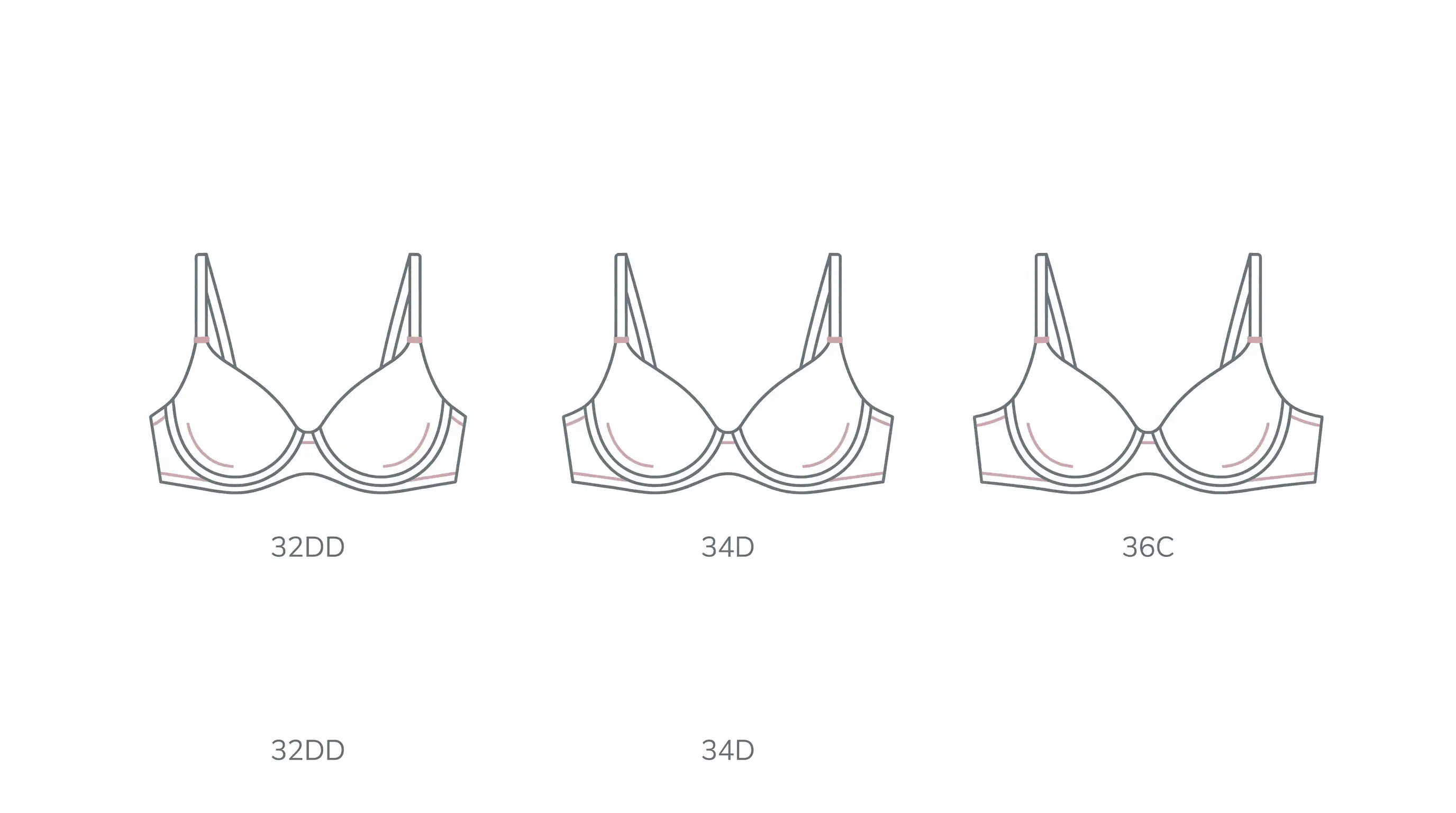
The Sister Size Matrix
Find your current size in the matrix below. Sizes in the same row hold a similar cup volume while the band gets tighter or looser.
| Smaller Band Larger Cup | Smaller Band Larger Cup | Starting Size | Larger Band Smaller Cup | Larger Band Smaller Cup |
|---|---|---|---|---|
| 28D | 30C | 32B | 34A | 36AA |
| 28DD | 30D | 32C | 34B | 36A |
| 30DD | 32D | 34C | 36B | 38A |
| 30E | 32DD | 34D | 36C | 38B |
| 32E | 34DD | 36D | 38C | 40B |
| 32F | 34E | 36DD | 38D | 40C |
| 34F | 36E | 38DD | 40D | 42C |
| 34FF | 36F | 38E | 40DD | 42D |
| 36FF | 38F | 40E | 42DD | 44D |
Common Sister Size Examples
These are common examples people search for when comparing nearby bra sizes:
When NOT to Use a Sister Size
Sister sizing is useful for fine-tuning, but you should usually stay within one sister-size step of your true starting size.
If you measure close to a 32D, buying a 36B just because it is available is usually not a good idea. Even if the cup volume looks close on paper, the bra proportions change too much and support often gets worse.
When Sister Sizing Will Not Fix the Problem
Sister sizing is not the answer to every bra fit issue. Sometimes the problem is not the band at all.
What Matters More: The Sister Size Chart or Actual Fit?
The chart gets you close. Actual fit tells you whether the new size is really better.
Signs the sister size is helping
Signs it is the wrong fix
If fit still feels off after trying one nearby sister size, recheck your measurements, compare with the bra size calculator, or review the fit issue guides to see whether the real issue is the band, the cups, or the bra shape.
Frequently Asked Questions
Are sister sizes exactly the same fit?▼
No. Sister sizes keep a similar cup volume, but the overall bra will not feel identical. The band length, strap placement, underwire width, and frame proportions still change, so sister sizing works best for fine-tuning rather than replacing your true size completely.
What is the sister size for a 34C?▼
The closest sister sizes for 34C are 32D if you need a tighter band and 36B if you need a looser band.
If my bra cups fit perfectly but the band is too tight, what should I do?▼
Go up one band size and down one cup letter. For example, if 34D feels too tight in the band but the cups feel right, try 36C.
Can I go up two sister sizes if my size is out of stock?▼
Usually no. Moving more than one sister-size step away changes the bra’s proportions too much. Support, wire position, strap placement, and overall feel often get worse even if the cup volume seems similar on paper.
What if both the band and the cup feel wrong?▼
If both parts feel wrong, sister sizing is usually not the best first fix. Recheck your measurements, compare your starting size again, and use fit signs to understand whether the issue is the band, the cup, or the bra shape itself.
Does sister sizing fix cup gaping?▼
Not always. If cup gaping happens because the cup shape is too tall, too open, or wrong for your breast shape, sister sizing may not fix it. Shape mismatch and style mismatch are common causes too.
Find Your True & Sister Sizes
Our calculator helps you estimate your main size and also explore nearby sister sizes when the band feels slightly too tight or too loose.