Sports Bra Sizing & Impact Guide
Last updated: March 2026
A sports bra is not just a tighter everyday bra. The right one depends on support design, impact level, and whether the fit actually controls movement once you start exercising.
How this page helps
This page helps you choose a better sports-bra fit by understanding support level, movement needs, and common signs of poor fit.
Method
The guidance on this page is based on common sports-bra support principles, fit checkpoints, and activity-based use patterns.
Expert Reviewed
By Pooja Panwar • Lead Bra Fit Specialist
Quick answer
Small to moderate support needs
Compression or hybrid styles can work well, especially for low to medium impact activity.
Larger support needs
Encapsulation or hybrid bras with stronger structure usually control movement better, especially for high impact.
Low impact exercise
Yoga, Pilates, walking, stretching, mobility work, and slower strength sessions usually need gentler support.
High impact exercise
Running, HIIT, jumping, aerobics, and court sports usually need the strongest movement control.
Best rule: choose your sports bra based on the most bounce-heavy part of your workout, not just what feels comfortable while standing still in the fitting room.
Start here based on your workout
I only need something for yoga or walking
Start with low-impact support unless you personally prefer a firmer feel.
Go thereI run, jump, or do HIIT
High-impact support should be your default starting point, especially if bounce is distracting.
Go thereI do not know if I need compression or cups
Use the compression vs encapsulation section first, then choose support level.
Go thereMy sports bras feel fine still, but fail when I move
You need the bounce test and fit-check sections, not just a softer fitting-room impression.
Go thereWhy everyday bras fail at the gym
Sports bras are built for repeated movement, not just standing support. A normal bra may feel acceptable for a short walk, but it usually does not control bounce well enough for running, HIIT, jumping, or fast direction changes.
More than up-and-down bounce
Exercise creates repeated multidirectional motion, which is why support needs are different from normal daily wear.
Support affects comfort
Poor support can make exercise feel distracting, uncomfortable, and harder to sustain consistently.
Tighter is not always better
True support comes from the right design, band stability, and activity match, not painful compression.
Compression vs encapsulation
Before choosing low, medium, or high impact, understand how the bra is built to control movement.
Compression bras
Compression styles hold the breasts closer to the chest wall as one unit. They are often pull-over styles and can work well for lower-impact activity or smaller to moderate support needs.
Encapsulation bras
Encapsulation styles support each breast more individually using separate cup structure or shaping. They are often more effective for fuller busts and higher-impact movement.
Most practical reality: many of the best sports bras today are hybrid styles. They combine compression and encapsulation instead of being purely one or the other.
Choose your impact level
Pick the bra for the hardest or bounciest part of your session, not the calmest part.
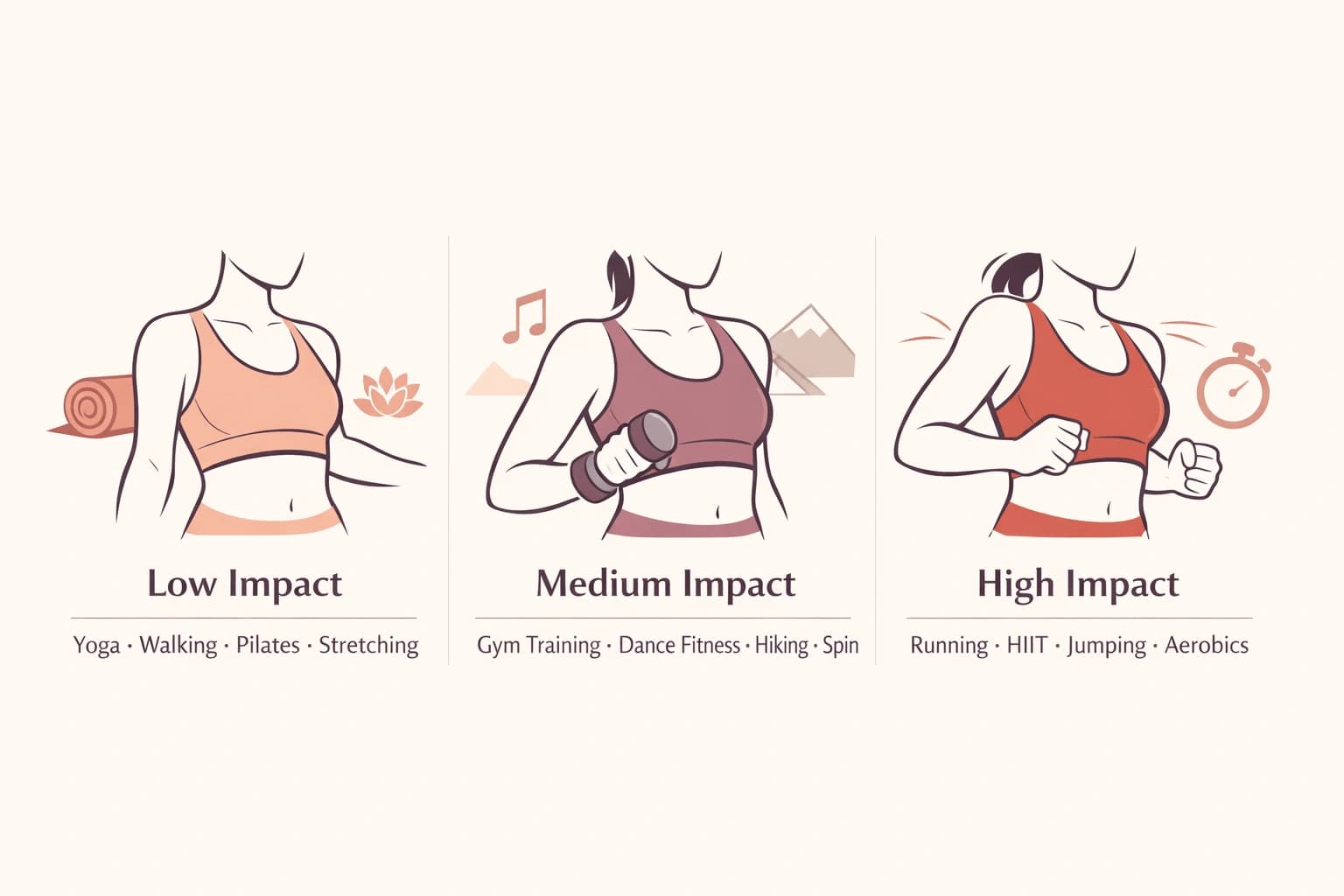
Low Impact
Comfort-first support with lighter control. Good for movement with less bounce demand.
Best for: Yoga, Pilates, walking, mobility work, casual cycling
Gentler training days, smaller to moderate support needs, or anyone prioritizing flexibility over maximum hold.
Medium Impact
A middle-ground level that offers more hold than lounge-style bras without the full lockdown feel of high-impact support.
Best for: Strength training, hiking, spin, dance fitness, brisk walking
Mixed training days or workouts with moderate movement but not repeated aggressive jumping.
High Impact
Maximum movement control. These bras usually need the strongest band, more stable cup support, and less forgiving fabrics.
Best for: Running, HIIT, jumping rope, aerobics, field and court sports
Anyone doing repetitive bounce-heavy activity, especially with fuller busts or if breast pain starts easily during exercise.
What good sports bra fit feels like
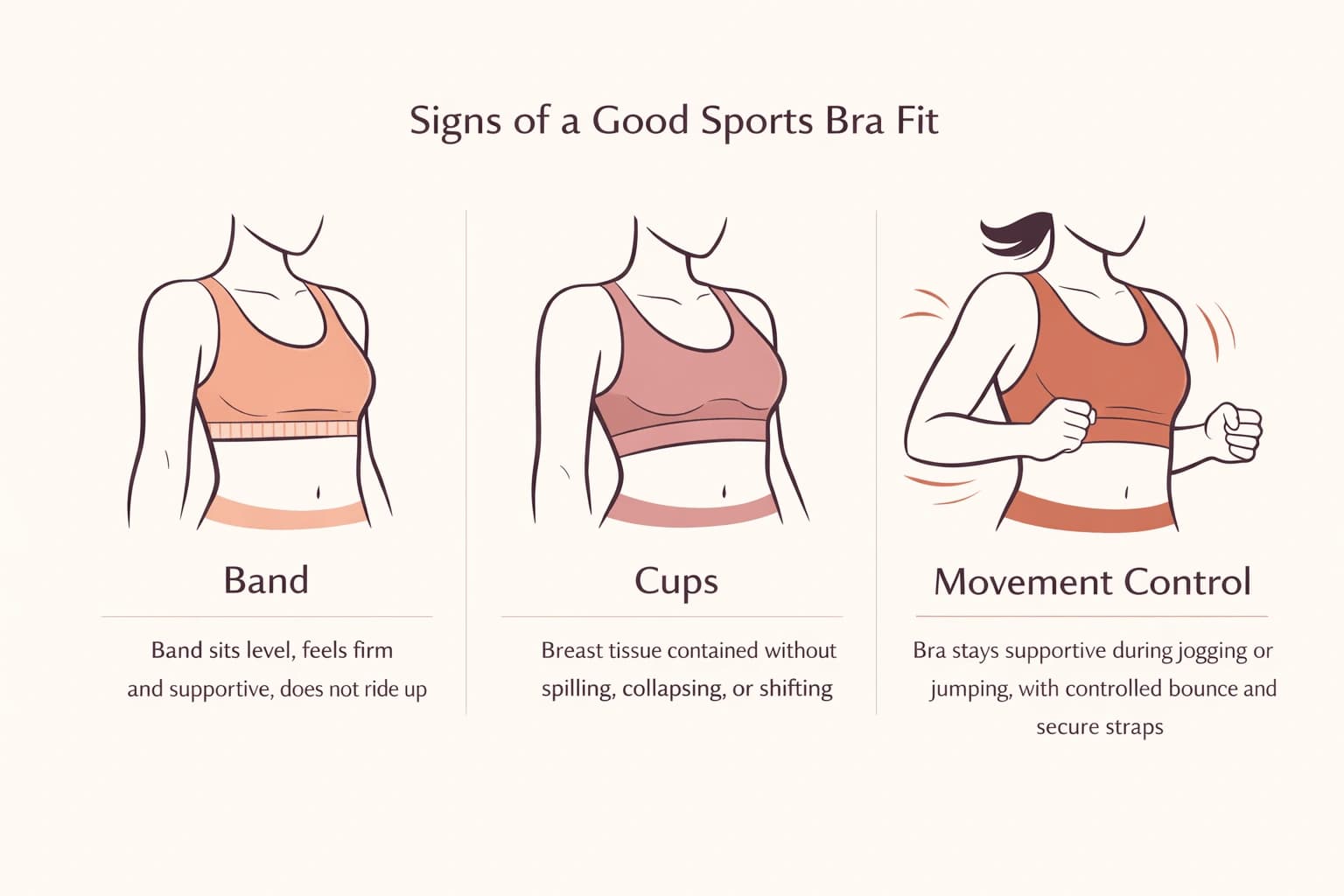
The band feels firm and level around your body without riding up during movement.
The cups contain all breast tissue without spillage, folding, or empty space.
The straps feel secure but do not dig in or do the band’s job for it.
You can breathe deeply and move your ribcage without feeling painfully compressed.
During jumping, jogging, or quick direction changes, your breasts move with your body rather than separately from it.
The bounce test
Never judge a sports bra while standing still only. Jog in place, do a few jumping jacks, or simulate the movement you actually train with.
Good sign
Your breasts move with your torso in a controlled way, the band stays level, and nothing shifts or escapes.
Bad sign
The band lifts, the cups gap or spill, the straps dig harder as you move, or the bounce still feels distracting.
Choose by workout
If you know the workout, this section makes the support choice faster.
Yoga / Pilates / Stretching
Low-impact sports bras are usually enough unless you personally prefer more support.
Gym / Strength Training
Medium-impact support is a common sweet spot, especially if your workout includes dynamic movement between sets.
Running / HIIT / Jumping
High-impact bras are the safer default because repeated bounce adds up quickly.
Mixed workout days
Choose support based on the hardest or bounciest part of the session, not the warm-up.
Common sizing mistakes
When the issue is style, not size
Sometimes the band and cup size are roughly fine, but the sports bra still fails your workout. That usually means the problem is support architecture, impact mismatch, or overall design.
Likely a size problem
- • Band rides up
- • Breathing feels painfully restricted
- • Clear spillage or obvious empty space
- • Straps dig because the band is not doing enough work
Likely a style or support problem
- • Feels okay standing still but not during movement
- • Support level does not match your workout
- • Compression style feels flattening but still unstable
- • You need more control, not just a tighter fit
Related guides and next steps
Find your bra size first
Use the bra size calculator before shopping for sports bras so your starting band and cup fit are grounded.
ExploreHow to measure bra size
Recheck your base size if your sports bras always feel unstable, restrictive, or inconsistent.
ExploreSigns your bra fits wrong
Use the fit guide if you want to compare sports-bra issues with everyday-bra fit problems too.
ExploreFrequently asked questions
Should I size down in a sports bra for better support?▼
No. A sports bra should feel firmer than an everyday bra, but it should not restrict breathing or painfully compress the chest. If you need more support, choose the right support design and impact level rather than sizing down aggressively.
What is the difference between compression and encapsulation sports bras?▼
Compression bras hold the breasts close to the chest wall as one unit, while encapsulation bras support each breast more individually with separate cup shaping. Many high-support bras use a hybrid of both ideas.
Can I wear a normal bra for workouts?▼
A normal bra is not built for the repeated multidirectional movement of exercise. It may feel fine briefly, but it usually does not control bounce well enough for running, HIIT, or jumping activities.
How do I know if my sports bra is too loose?▼
If the band rides up, the cups shift, the straps keep falling, or your breasts bounce independently from your torso during movement, the bra is not supportive enough for that activity.
How often should I replace a sports bra?▼
Sports bras wear out faster than many everyday bras because they are exposed to sweat, repeated stretching, and more frequent washing. Replace them when the band softens, support drops noticeably, or the fit no longer feels stable.
Can the same sports bra work for yoga and running?▼
Sometimes, but not always. A bra that feels comfortable for yoga or walking may not control movement well enough for running or HIIT. Match the bra to your highest-impact activity.
Why does my sports bra feel fine standing still but bad during exercise?▼
Because static comfort and movement control are not the same thing. A bra can feel soft and acceptable in the fitting room but still fail the bounce test once you jog, jump, or change direction quickly.
Can a sports bra be too tight even if it feels supportive?▼
Yes. If it makes breathing feel restricted, creates pressure pain, causes chafing, or leaves deep marks quickly, it may be too tight or the design may be too compressive for your body.
Before buying low, medium, or high-impact bras, make sure your base size is reasonably accurate. Use the bra size calculator first, then choose the sports bra architecture and support level that matches your workout.
Start with your bra size first
Sports bra shopping gets easier when your starting band and cup size are already grounded. Then you can focus on impact level, support style, and movement control.